Showing posts with label Americana. Show all posts

Friday, August 27, 2010

Baby, You're Lost Out There In A Different Place

[*A correction to something I said yesterday: those pick-up trucks?  The ones backed up against the fence?  Those might as well be V.I.P. seats.  You have to reserve one of those spots (though they usually go to the parents of the teens in The Scramble - no better place to cheer on your kid than at ground level, where they might be able to hear you under their helmets).]


[*And my apologies for the increasing lack of picture quality.  We lost the light as the event rolled into the evening, and however bright the stadium lights might have made things, it just couldn't compare to the light of the sun.  Sorry.] 

Anyway.  The Scramble.

The rules are simple.  High School girls participate in the Pig Scramble.  If you catch a pig, you have half an hour to get the pig into the chalk circle at the center of the arena.  As long as your hands are on the piggy, it's yours - no one can come and steal it out of your arms.  But if you lose your hold on the pig?  Then it's fair game.  And if you get your pig to the circle, you're guaranteed an animal to raise and show at next year's fair.

The piggies scatter as the girls run into the herd, diving face first into the mud, scrabbling for pig legs.  Some of the lucky pig-catchers gamely get their legs under them, hauling the animals off the ground and carrying them to the circle.  They know this is not a game of stamina.


The others hunker down over their pigs, holding them still with their whole bodies until they can work out a plan of attack.  

(Don't fret for the piggies, though.  These animals weigh just as much, if not more, as the girls lying on top of them.  If anyone's feeling broken and abused by the end of the night, it's not the ham.)


From there on, the techniques vary.  Most shimmy their way forward on their knees, arms tightly latched around the pig beneath them, pushing their way towards the circle one agonizing inch at a time.  The vultures have descended at this point, girls with empty hands standing at the ready over the mud-covered pig-holders, waiting for the moment the pork makes a run for it.  Last year's participants are also nearby, barking out warnings to the troublemakers trying to startle the animals, and ready to help the exhausted winners out of the mud.  

One by one, the piggies get to the circle.  One girl lays on her side and kicks her way backwards through the mud to the chalk.  Another, to the delighted cheers of the crowd, wraps her arms and legs around the animal, and barrel-rolls herself and her pig to the center of the arena.  The stadium roars when the last girl drags her pig home, and she leaves the arena with jelly legs, while the rest of the challengers leave with mud.


The Calf Scramble isn't much different, though everything feels like it's been kicked up a notch. 

 
Teenaged boys are released into the arena to chase down the calves.  Once they get their hands on the beef, they have forty-five minutes to correctly tie a harness on the animal and lead it into the newly drawn chalk circle.  Like the pig scramble, as long as you're touching the animal, it's yours, and like the pig scramble, if you lose it, you're out of luck.  Get the calf to the circle, and you've got an animal to show at next years fair.

The stadium rumbles under the cheers of the crowd, the energy of the boys, the racing of the calves.  Over the loudspeaker, the announcer tells us that only one of these animals weighs less than 500 pounds, and we hold our breath when a boy disappears under the legs of a beast.  He pops up right after, covered in mud but no worse for wear.


Number 8, the only boy not taller than a calf, captures our hearts when he pushes the sleeves of his too-big sweatshirt up over his hands and throws his arms around the first animal that comes his way.  He digs his heels deep into the mud, and sets to tying his harness around the calf's head.  We cheer his certain victory.

On the other end of the arena, other boys have caught and harnessed their own animals, but there's still one rogue on the loose.  It runs from one end to the other, down to the place where Number 8 is leading his stubborn calf towards the circle.  The rogue barrels through the space between them, ripping the rope out of Number 8's hands, and the crowd boos as a vulture swoops down and hastily unties the harness from the newly liberated calf.  Number 8, with mud on his front and his hands rubbed raw, hangs his head.  He will not win a calf today.


The rest of the evening is less inspiring.  The boys with the longest arms wrap the leads around one hand, and wrap their other hand around the tail to better navigate their stubborn calves.  The rest just dig their boots deeper into the slippery mud, pulling forward while the animals plant their feet and push decidedly backwards.  And if one of last year's boys comes around the back to give the beast a motivating slap on rump, just to move things along, well, maybe we all pretend not to see it.

Thursday, August 26, 2010

Everything is Fine and She's Now Mine


I almost forgot about the fair.

That's no small feat, let me tell you.  Springfield, Ohio is the birthplace of 4-H (there's a plaque on the sidewalk and everything, so you know it's real), so the Clark County Fair is quite the event 'round these parts.  We've gone every year that we've been here, though it's sometimes been out of duty instead of desire.


So we'll go, and do the fair things: walk the midway with a bag of cotton candy; stroll through the produce pavilions, and wonder what makes this zucchini better than that zucchini; coo over the (big) little piggies and chuckle darkly at the Pork Producers' stand selling delicious chops just across the way from the barn, the smell of barbeque just nearly masking the smell of manure.


But the main event, the one that the folks here come back to year after year, packing the stadium full on a Friday night (and if there are no seats left in the bleachers, they just pull their pick-up trucks around to the other side of the arena) is The Scramble.


It starts with the Kiddy Pig Chase.  While the parents cheer them on from behind the chalk line, children run barefoot through the mud, chasing down four pigs, hoping to catch one of the red ribbons tied around the piggie bellies.  There's a bit of drama - there always is.  Parents who won't stay behind the chalk lines like they're told.  Parents who are so sure that their child got to the ribbon first.  A rumor floats down the line that one of the kids, outraged that she wouldn't be able to keep the ribbon she stole from the hands of another child, bit one of the teenage volunteers in the ankle.


But outside of the few sour grapes, the pig chase goes well; the winners get their prizes, and the rest happily splash in the mud puddles until their parents come to collect them.

The teen volunteers heard the pigs into their pens as quickly as possible, so as to spend the most amount of time playing "Who Can We Make the Most Dirty Against Their Will?", which does include the time honored trick of kneeling behind another person's legs and waiting for them to step backwards.  Even the Fair Queen gets in on the act, walking delicately across the arena in her clean white dress, mud slicked up the backs of her thighs.


Once all the kids are safely out of the mud, a volunteer runs out to re-draw the chalk lines, adding a big white circle in the middle of the stadium.  It's nearly time for the Main Event.


The Scramble.


Come back tomorrow, and hear the rest of the story.

Friday, June 4, 2010

Children At Your Feet. Wonder How You Manage to Make Ends Meet.

There's a woman standing on the side of the road in Springfield, Ohio.  We've passed her and her children many times before without recognizing her.  All day she stands there, all day she watches.  She holds her children close to her, and glows a warm pink in the light of the setting sun.  She is a mother.  She is a wife.  She is Madonna of the Trail.


There are twelve Madonnas positioned across the continental United States, all but two facing westward.  Following the line of the National Old Trails Road (now mostly Rt. 40 and Rt. 66) from Bethesda, Maryland to Upland, California, these women were erected to honor the women of the frontier, the wives and daughters who were so strong and who so loved the men with whom they crossed the nation.  The presence of these women established the expansion of the American territories as much as their adventurous husbands did, and for this they are recognized.

In 1911, the Daughters of the American Revolution formed the National Old Trails Road Committee, and were tasked with the establishment of the route as a National Memorial Highway.  The dawn of World War One delayed the formal start of the project, but in 1924 Congress approved the plan to erect twelve statues along the Memorial Highway.  German-American sculptor August Leimbach was drafted to design the statue.  He describes his woman as such:

"When I came to America, I often saw these people of the pioneer type, strong and brave and always ready to protect themselves against any danger. Asked to make a sketch model for a monument of a woman of pioneer days, I was inspired by my own impression of these people I had met, and the Madonna of the Trail is the result."


And this woman is no dainty bread maker or house keeper.  She's a sturdy woman, face turned to brave the west.  She holds her baby with one arm while her son clutches her skirt.  And in her free hand?  A rifle.  No, this is no ordinary woman.  This is a woman who built homes.  This is a woman who conquered lands.  

The algonite stone used to build her heavily features Missouri granite, which causes her healthy pink coloring.  I don't know if they did that on purpose, if they thought that casting her in this delicate, feminine color would soften the harshness of her dominating figure.  The color doesn't soften her, not exactly.  Instead, it lends her an air of motherly stoicism.  Now she has a hint of personality, more than you might find if she were just another stark white memorial.


On July 4, 1928, at the dedication of the first statue, the one right here in Springfield, the leader of the National Old Trails Road Committee, then Judge (but soon to be President) Harry Truman said of these women:   "They were just as brave or braver than their men because, in many cases, they went with sad hearts and trembling bodies. They went, however, and endured every hardship that befalls a pioneer."  Within the next nine months, each of the twelve identical statues had been placed and dedicated, the final one resting at the start of the trail in Bethesda, Maryland.  They've since become a source of local pride, with the community taking care to see that their women are not defaced, or too harshly weathered.  They still stand today, that strong line across the country.

I still drive past our Madonna.  I am glad now to know her name.  

Tuesday, May 25, 2010

Do You Know the Muffler Man?

Muncie, Indiana.  Spring 2010.


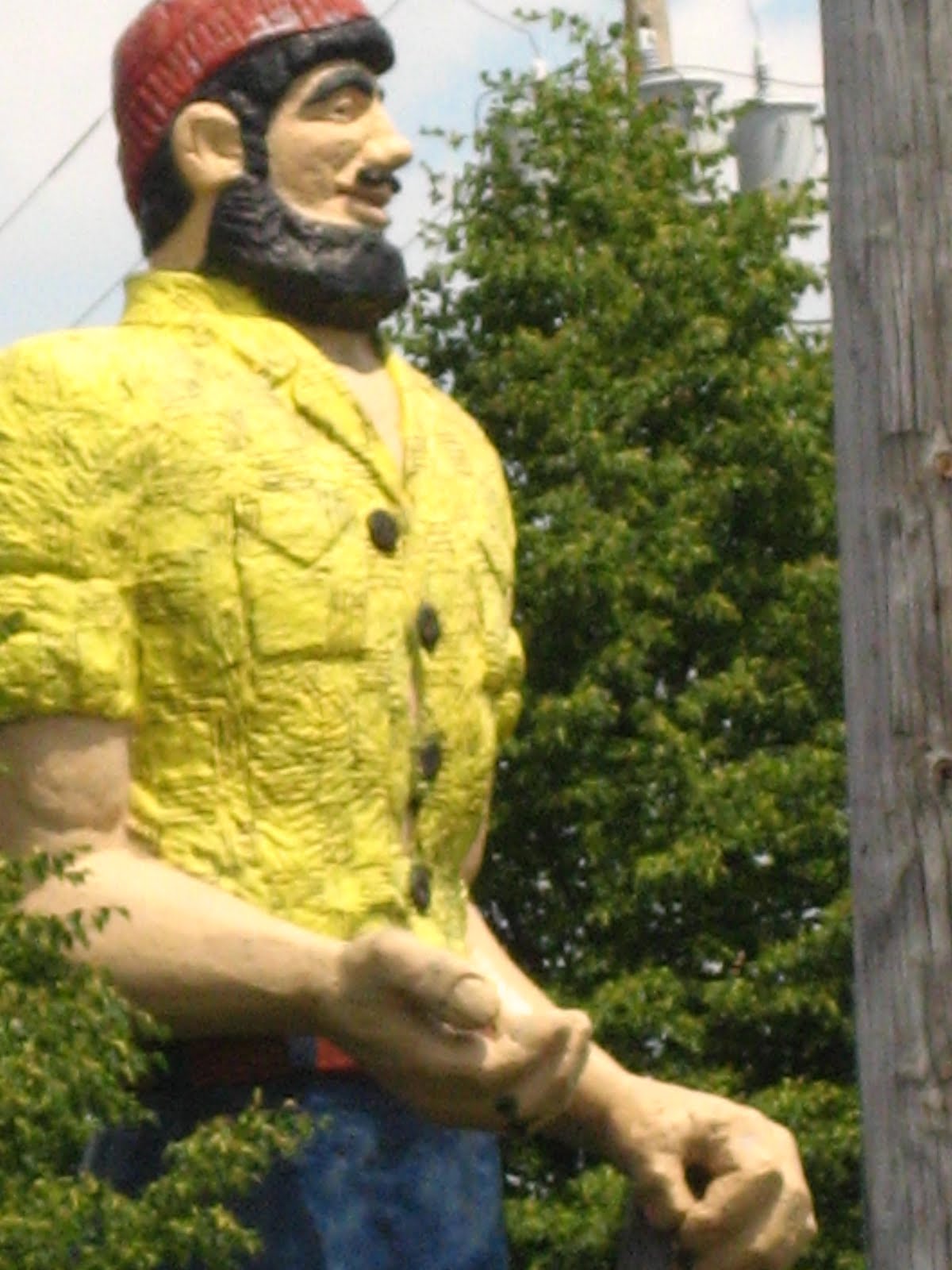
I'm excited when I tell Sarah she's got a piece of pure vintage Americana practically in her backyard.  "You've got a Muffler Man!" She's not quite as enthused as I am, but she gamely asks where it is.  "Oh, is that what that is?" she asks when I tell her he stands in the parking lot of a bar named Timbers.  "We just call him the giant lumberjack."

And a giant lumberjack he is.  But he's so much more than that.


In the 1960's we built giants.  Fiberglass giants.  The first Muffler Man was built in 1962 by a company called Prewitt Fiberglass.  It was a Paul Bunyan statue, and it stood outside the PB Cafe, along Route 66.  Prewitt Fiberglass was absorbed into International Fiberglass shortly after, and they continued to install the odd man in front of out of the way cafes.  And suddenly these places started reporting a dramatic upswing in earnings, and word got out that a fiberglass man was good for business.  And in the decade that followed, everyone wanted a giant for their front lawn.


Not just any giant man is an official Muffler Man.  There are signs, indicators that the men all came out of the same mold.  The lantern jaw.  The broad shoulders.  Arms bent at the elbow, one hand facing up and the other facing down, the better to hold his ax, or muffler, or any number of accessories crafted specially for the giant's grasp.  There are variations, of course.  Add a stetson to your classic Man and now he's a cowboy.  A wooly beard, knit cap, and a plaid painted shirt gets you an official Paul Bunyan.  The Native American model, so charmingly called The Brave, is a bit of a sticking point for Muffler Man enthusiasts (don't laugh!  They do exist!).   He doesn't bear the traditional markings of the Muffler Man - his features are narrower, his chest is bare, and he has one arm raised in the "How" greeting.  But the more liberal devotees of roadside Americana recognize the long, long history of putting an indian in front of your store to bring in business, and honor him just the same.    


They used to be everywhere, or so I'm told.  I'm a generation or two too late to really appreciate the heyday of the Muffler Man.  There are plenty still around, but they're harder to find.  Few, if any, are still with their original owners, and many have been so heavily modified that they barely resemble their original state.  Some are hidden away, as if the owners are ashamed that, as a population, we were ever so taken with something so frivolous.  I miss the time when things were allowed to be frivolous.

The Muncie Lumberjack is not, technically, an official Muffler Man, but an untrademarked hybrid that upholds the legacy as much as any official Man, Uniroyal Gal, or Texaco Big Friend can, standing tall and proud outside Timbers Bar.  Next to the adult video store. 

HTML hit counter - Quick-counter.net