Some of the angels of Woodland Cemetary. There were others, but they were eaten by the faulty card reader.
Showing posts with label Cemetery. Show all posts
Friday, July 16, 2010
Wednesday, June 9, 2010
Woodland: Persons of Interest
But I'm not here for burials. I'm here for graves. Famous graves.
The name Johnny Morehouse might not mean anything to you, but it's arguably the most recognizable grave in Woodland. It's so well known, there's a little marker next to the site that says "Tour Stop 1." Little Johnny's first in line.
The story goes that five-year-old Johnny fell into the Miami & Erie Canal while playing near his home. His faithful dog jumped in after him, and managed to pull the boy out, but not in time to save his life. That part is true, but the legend that follows is a classic one; the dog was so bereft at the loss of Little Johnny that he sat at the grave morning, noon, and night. Visitors were so concerned, they began to leave little plates of food for man's best friend.
Toys and coins are still left behind for Little Johnny. It's highly unlikely that any of these people are connected to the Morehouses in any way, but the tradition lives on. There's a woman who walks the cemetery every day who collects the coins left behind on Johnny's grave, and uses the money to buy another small toy for Johnny's collection.
Undeniably, the most famous grave at Woodland belongs to the Wright brothers. There are plenty of Wright's here, but only Orville and Wilber are buried under the Ohio and American flags. This is the first time I've encountered pennies left behind on gravestones. The internet tells me that this is a sign of respect, that visitors leave behind coins to honor the legacy of the deceased. (Folklore also says that if you drop a penny on a grave and make a wish, the person's spirit is honor bound to help it come true.) The next time I visit a cemetery, I'm bringing with me a pocket full of pennies.
Just beyond the Wrights is a purple flag marking the grave of Paul Laurence Dunbar, one of America's first prominent African-American poets. Set against his memorial stone is a marker for his wife, Alice Dunbar. I don't know if she's buried here - she died in Philidelphia 29 years after her husband's passing, and remarried twice. Alice was a prominent poet, journalist, and activist in her own right - I imagine if she were also buried here, Woodland wouldn't hesitate to claim her.
Someone's left a pair of quarters on Paul's stone - a friendly competition with the Wrights? They knew each other in life - Paul went the same school as the Orville and Wilber. In fact, his first writings appeared in a paper put out by the brothers, who owned their own printing press. They later invested in the Dayton Tattler, the area's first African-American paper, edited and published by Dunbar. Small world.
The last grave I want to see is the marker for Erma Bombeck. There's a helpful sign to point me the direction of her final resting place. I follow the arrows and look. And look. And look.
There are no words on Erma's grave, nothing to indicate that here lies a person. If you don't know what you're looking for, you'd never find it. Up until the writing of this article I thought I'd missed her completely, until I saw a picture of her memorial and realized that she and I had been together the whole time.
I snapped a picture of the stone because there was a wreath against it. I didn't know it meant anything at the time. The rock comes from Arizona - Erma's husband Bill wanted to remember her with a piece of Phoenix, where the pair spent 25 years together. Erma herself was a well-respected journalist and humorist before she died. I think this unmarked grave might be her last great joke.
There are plenty of other famous graves at Woodland: Leslie Carter, 'The American Sarah Bernhardt"; Levi and Matilda Stanley, the King and Queen of the Gypsies; George P. Huffman, maker of Huffy Bicycles; and too many more to mention. Plan your own visit to Woodland, and see a bit of history.
Tuesday, June 8, 2010
Woodland
I was a bit of a fatalist as a child. Emo before I knew what the word meant. I've grown out of it enough to visit a cemetery without being overwhelmed by the inevitability of my demise, but not enough to forget that there a people down there.
Walking through Woodland Cemetery in Dayton, I find myself saying "Excuse me" when cut between the graves, or "Pardon me, Fannie" when I lift a fallen branch or brush away some dirt for a better picture. I apologize when I trip over the stones so small they're little more than nubs in the overgrown grass. I wonder about those little stones; were they bigger once? Taller? And they've now been so broken and so weathered that they've been worn down to these little bumps on the ground? Or was the family simply too poor to afford much more than a bare minimum marker for the grave, so they've placed this little stone here for remembrance. I find a few little stones with initials stamped on the top; I think it might be the latter.
Memorial Day wasn't that long ago, any many of the graves still have their flags and wreaths, though there's a helpful sign at the entrance informing all visitors that these decorations will be removed and disposed of by the end of the week. With the exception of the solider's plot in the front section, I stay away from those marked with memorial wreaths, ribbons, and flowers. I doubt their family intended for their veterans to be my photo op.
Woodland's an interesting place. It's mostly hill, and there's line of mausoleums built along the road, right into the side of one of the mounds. It's a big monument cemetery - Dayton used to be where the money went, and anyone who could afford a big rock, got the biggest rock they could. There are a lot of obelisks, leaving the landscape looking like it's dotted with hundreds of tiny Washington Monuments. There are enough oversized crosses for the cemetery to host a "Crosses of Woodland" feature on their website, and many, many angles. Angles with their hands raised in praise. Angles mournfully touching the family stone. Angles weeping at the feet of the family plot. Those might be my favorite kind.
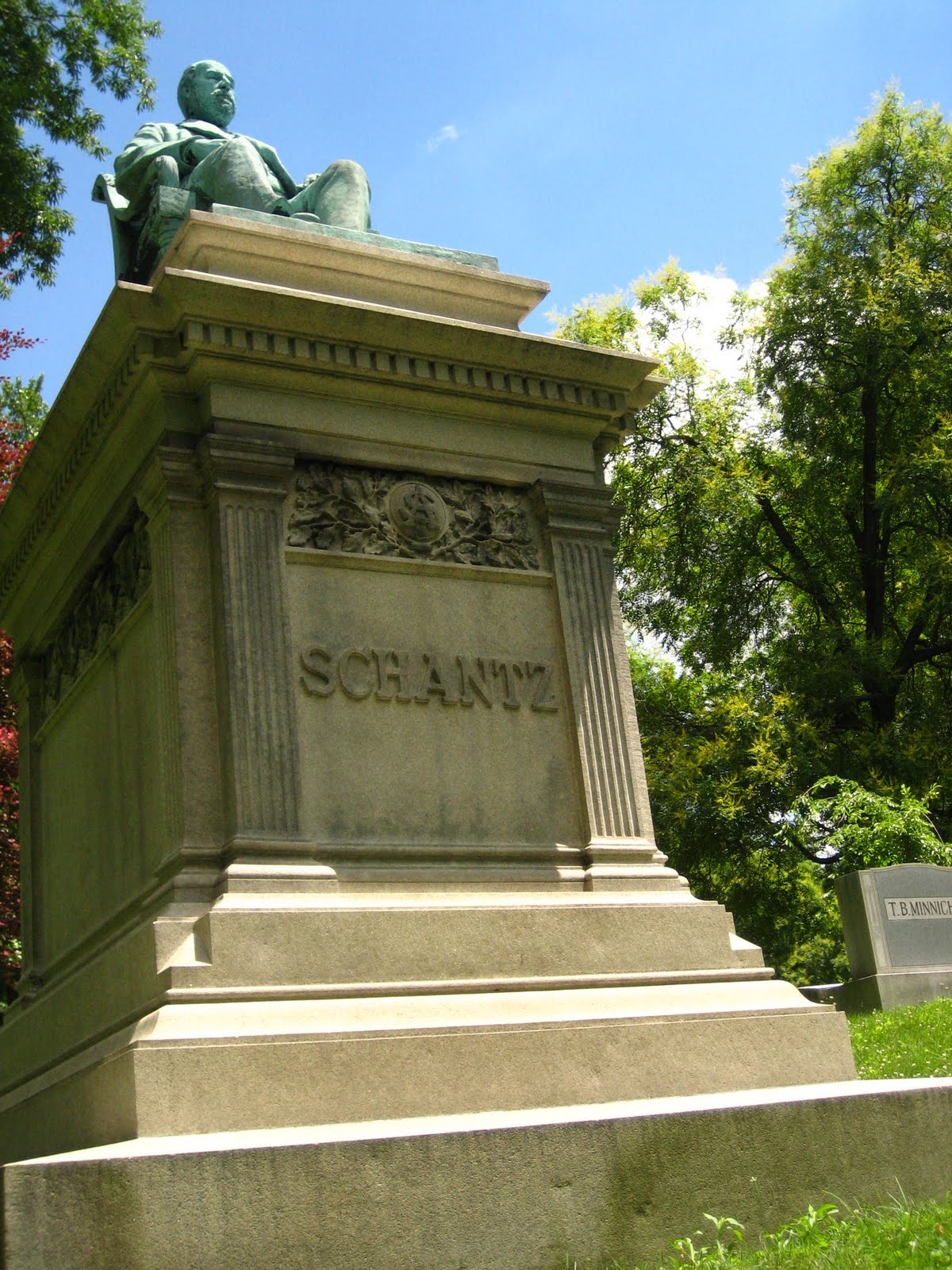
I do tend to gravitate towards the more audacious graves, the ones that are so over the top they start to suggest at a sense of humor from the person who commissioned it. There's a copper statue of a man at the Woodland entrance, reclining in his chair atop a massive block of concrete. It's the first thing you see when you drive in, and how could you not? It's huge. It demands your attention. Clearly, this is a man who understood that the dead have no need for modesty, and I salute him for it. This is his only lasting impression, and now everyone who walks through the gates will notice him. I hope I can be so bold.
I walk too far looking at the names. There's a strong line of German heritage in this area of Ohio, and I try to spot which surnames used to have an umlaut. Did poor Oliver Gunkel's family lose something in the Americanization of their name? And what about the stones that just say "Mother" or "Father" or "Mary"? There's no family plot stone to say who they belonged to, nor are there dates on these stones, saying when they died.
I end up in the Greek-Orthodox section. I can tell it's the Greek-Orthodox section because of all the Greek.
I've also walked as far as I can go, and it's much further than I intended. There's a fence in front of me, separating the cemetery from the great beyond, and I've walked up an down so many hills that if I can no longer see my car. I know that if I just put my back to the street and walk in a thiswardly direction, I'll eventually find it. Or I'll end up back at the entrance, and I can pick up one of those maps they (allegedly) have on offer. Squaring my shoulders, I start the trek back up the hill.
And there in front of me at the top of that first hill, is this:
Preserved Smith. Were it not for actor Benedict Cumberbatch, Preserved Smith might be my favorite name ever committed to a real person. The heartiness of "Smith." The descriptiveness of "Preserved." We don't much name our children for adjectives anymore. Or words in general (unless your a celebrity scientologist. Pilot Inspektor, anyone?). But the virtues still remain.
(I don't know for certain if this Preserved Smith is the Preserved Smith, but wouldn't it be a tickler if it was? The man died in Kentucky, but he was born in Cincinnati, so let's assume they're the same man. Just how many Preserved Smiths can there be, anyway?)
Come back tomorrow to learn about some of Woodland's most distinguished guests.
Sunday, May 9, 2010
Mount Tabor
West Liberty, Ohio. Spring 2010.
We stumbled upon this church almost by accident. Driving home from the Ohio Caverns, the GPS said, "Turn right," but Mom went straight on.
"I think you were supposed to turn there."
"No," she said, pointing at the hill in front of us. "I want to go there."
'There' was a little church with a little iron fence, surrounded by (mostly) little headstones. We slowed to a crawl in front of an opening in the gate (bless those country roads - not another car in sight) and oo'ed at the American Gothicness of it all. The iron letters across the front gate say 'Mt. Tabor Church and Cemetery "Do you want to go in?" No need to ask twice.
It's old. The first stone we come to is so worn by time and the elements the name has all but disappeared. I can feel the slight depressions where the letters were carved, but they're so poorly defined you'd never find out who was buried there, even if you did a rubbing. I always feel bad for graves like that. I know that somewhere, probably in the church, there's a big book with a big list of all the names of everyone buried in the graveyard, that there will always be a record of the person buried underneath this weather-worn marker, but that doesn't seem to matter.
My dad used to drag us to cemeteries when I was a kid. It wasn't a regular occurrence, but he's always been a bit of a history buff and spent a lot of time on our family tree - if he'd find that someone's grandfather's uncle's second cousin was buried nearby, we'd all take a pilgrimage to the grave site so he could take a picture. Document the bloodline, as it were. No one's second cousin's nephew's grandson is going to take a picture of these naked stones, though.
And poor Lydia. There a plenty of broken stones in this cemetery. Most of them have been left with the tops leaning up against their bottoms, but both halves of Lydia's marker have been propped up against someone else's memorial. Was she buried nearby, or were her broken pieces moved because they were unsightly? Why not leave them lying in the grass over her grave, the way some of the smaller stones are? Why doesn't Lydia have a last name?
There are little stars next to some of the graves. In the newer part of the cemetery, there's one for World War II, another for Korea. But the older ones indicate the War of 1812, and one stone engraved with "Soldier of Revolution" has a little banner that says "1776." That explains the Historic Ohio plaque standing just inside the front gates.
As warm as it is, it's been threatening to rain all day, and the wind is so fierce it's hard to stand upright. We don't stay long, but how nice to have discovered this little hidden treasure.
Subscribe to:
Posts (Atom)