Showing posts with label Ohio. Show all posts

Thursday, September 16, 2010

Word On The Street, You Got Something To Show Me

I don't get many opportunities to see peacocks, but at the Cincinnati Zoo, they roam the grounds at their own leisure.  I'd never seen a peacock show his feathers, so I had hoped that, before we left for the day, we might see one shake what his peacock mama gave him. 

After plenty who had no interest in showing off...
  

And one poor fella who tried so hard but didn't have much to show...


As we were preparing to leave the zoo, we heard the tell-tale rattle and coo of a peacock who was in the mood and ready to find himself a fun-loving peafowl. 


He was feisty, to be sure.  He'd managed to chase a lady bird into a small, semi-fenced enclosure, and, tail proudly displayed, proceeded to follow her around the pen, vibrating his feathers and clucking in a way I'm sure he thought was seductive, but really made him come across as every relentlessly skeevey guy you've ever met in a bar. 


Girlie was having none of it.  She'd wait until he came just close enough, then dart behind his tail, where he couldn't see her.  She scurried under a fence post, out into the zoo and away from his clumsy advances.  And he?  Well, he was left behind.  All dressed up, and no where to go.


Tuesday, September 14, 2010

If I Were A Moose And You Were A Cow, Would You Love Me Anyhow?


This is the Hugag.  It is a Fearsome Critter.


This is a moose.  It is also a Fearsome Critter.

There are few animals that, when I go to the zoo, I can look at from the outside and still truly know their awesome might.  One is elephants.  Another is bears.  And the moose.  Obviously.

I don't know what I'd do if I ever saw a moose in real life.  Lie down and wait for death, I suppose.  They can run up to 35 miles an hour.  Top human speed ever recorded is 30 miles an hour, but the average is only 11.  I'm... not top human.  I'm barely even average human.  There's no way I'm ever outrunning a moose.   


You might think it's silly to be afraid of something as goofy looking as a moose, but the people who spend their lives around them say that they can be more dangerous than bears.  I'll repeat that: MORE DANGEROUS THAN BEARS.  More people are killed or injured by a moose than by brown bears and black bears combined.  I imagine they all start like this:

"Hallo, Moose!  Moose, you are so big and warm and fluffy.  I just want to hug you forevOHNOGODWHY!"   

Easy precaution there, though.  Always resist the urge to hug a moose.  Fear the moose, respect the moose, and we all might get out of this alive.

That's an electric fence with a sprinkler on top.  


That's a moose lying next to a waterlogged electric fence.  Does it care?  No.  Why should it?  IT'S A MOOSE.

Friday, August 27, 2010

Baby, You're Lost Out There In A Different Place

[*A correction to something I said yesterday: those pick-up trucks?  The ones backed up against the fence?  Those might as well be V.I.P. seats.  You have to reserve one of those spots (though they usually go to the parents of the teens in The Scramble - no better place to cheer on your kid than at ground level, where they might be able to hear you under their helmets).]


[*And my apologies for the increasing lack of picture quality.  We lost the light as the event rolled into the evening, and however bright the stadium lights might have made things, it just couldn't compare to the light of the sun.  Sorry.] 

Anyway.  The Scramble.

The rules are simple.  High School girls participate in the Pig Scramble.  If you catch a pig, you have half an hour to get the pig into the chalk circle at the center of the arena.  As long as your hands are on the piggy, it's yours - no one can come and steal it out of your arms.  But if you lose your hold on the pig?  Then it's fair game.  And if you get your pig to the circle, you're guaranteed an animal to raise and show at next year's fair.

The piggies scatter as the girls run into the herd, diving face first into the mud, scrabbling for pig legs.  Some of the lucky pig-catchers gamely get their legs under them, hauling the animals off the ground and carrying them to the circle.  They know this is not a game of stamina.


The others hunker down over their pigs, holding them still with their whole bodies until they can work out a plan of attack.  

(Don't fret for the piggies, though.  These animals weigh just as much, if not more, as the girls lying on top of them.  If anyone's feeling broken and abused by the end of the night, it's not the ham.)


From there on, the techniques vary.  Most shimmy their way forward on their knees, arms tightly latched around the pig beneath them, pushing their way towards the circle one agonizing inch at a time.  The vultures have descended at this point, girls with empty hands standing at the ready over the mud-covered pig-holders, waiting for the moment the pork makes a run for it.  Last year's participants are also nearby, barking out warnings to the troublemakers trying to startle the animals, and ready to help the exhausted winners out of the mud.  

One by one, the piggies get to the circle.  One girl lays on her side and kicks her way backwards through the mud to the chalk.  Another, to the delighted cheers of the crowd, wraps her arms and legs around the animal, and barrel-rolls herself and her pig to the center of the arena.  The stadium roars when the last girl drags her pig home, and she leaves the arena with jelly legs, while the rest of the challengers leave with mud.


The Calf Scramble isn't much different, though everything feels like it's been kicked up a notch. 

 
Teenaged boys are released into the arena to chase down the calves.  Once they get their hands on the beef, they have forty-five minutes to correctly tie a harness on the animal and lead it into the newly drawn chalk circle.  Like the pig scramble, as long as you're touching the animal, it's yours, and like the pig scramble, if you lose it, you're out of luck.  Get the calf to the circle, and you've got an animal to show at next years fair.

The stadium rumbles under the cheers of the crowd, the energy of the boys, the racing of the calves.  Over the loudspeaker, the announcer tells us that only one of these animals weighs less than 500 pounds, and we hold our breath when a boy disappears under the legs of a beast.  He pops up right after, covered in mud but no worse for wear.


Number 8, the only boy not taller than a calf, captures our hearts when he pushes the sleeves of his too-big sweatshirt up over his hands and throws his arms around the first animal that comes his way.  He digs his heels deep into the mud, and sets to tying his harness around the calf's head.  We cheer his certain victory.

On the other end of the arena, other boys have caught and harnessed their own animals, but there's still one rogue on the loose.  It runs from one end to the other, down to the place where Number 8 is leading his stubborn calf towards the circle.  The rogue barrels through the space between them, ripping the rope out of Number 8's hands, and the crowd boos as a vulture swoops down and hastily unties the harness from the newly liberated calf.  Number 8, with mud on his front and his hands rubbed raw, hangs his head.  He will not win a calf today.


The rest of the evening is less inspiring.  The boys with the longest arms wrap the leads around one hand, and wrap their other hand around the tail to better navigate their stubborn calves.  The rest just dig their boots deeper into the slippery mud, pulling forward while the animals plant their feet and push decidedly backwards.  And if one of last year's boys comes around the back to give the beast a motivating slap on rump, just to move things along, well, maybe we all pretend not to see it.

Thursday, August 26, 2010

Everything is Fine and She's Now Mine


I almost forgot about the fair.

That's no small feat, let me tell you.  Springfield, Ohio is the birthplace of 4-H (there's a plaque on the sidewalk and everything, so you know it's real), so the Clark County Fair is quite the event 'round these parts.  We've gone every year that we've been here, though it's sometimes been out of duty instead of desire.


So we'll go, and do the fair things: walk the midway with a bag of cotton candy; stroll through the produce pavilions, and wonder what makes this zucchini better than that zucchini; coo over the (big) little piggies and chuckle darkly at the Pork Producers' stand selling delicious chops just across the way from the barn, the smell of barbeque just nearly masking the smell of manure.


But the main event, the one that the folks here come back to year after year, packing the stadium full on a Friday night (and if there are no seats left in the bleachers, they just pull their pick-up trucks around to the other side of the arena) is The Scramble.


It starts with the Kiddy Pig Chase.  While the parents cheer them on from behind the chalk line, children run barefoot through the mud, chasing down four pigs, hoping to catch one of the red ribbons tied around the piggie bellies.  There's a bit of drama - there always is.  Parents who won't stay behind the chalk lines like they're told.  Parents who are so sure that their child got to the ribbon first.  A rumor floats down the line that one of the kids, outraged that she wouldn't be able to keep the ribbon she stole from the hands of another child, bit one of the teenage volunteers in the ankle.


But outside of the few sour grapes, the pig chase goes well; the winners get their prizes, and the rest happily splash in the mud puddles until their parents come to collect them.

The teen volunteers heard the pigs into their pens as quickly as possible, so as to spend the most amount of time playing "Who Can We Make the Most Dirty Against Their Will?", which does include the time honored trick of kneeling behind another person's legs and waiting for them to step backwards.  Even the Fair Queen gets in on the act, walking delicately across the arena in her clean white dress, mud slicked up the backs of her thighs.


Once all the kids are safely out of the mud, a volunteer runs out to re-draw the chalk lines, adding a big white circle in the middle of the stadium.  It's nearly time for the Main Event.


The Scramble.


Come back tomorrow, and hear the rest of the story.

Wednesday, August 18, 2010


I must have zoo on the brain this week.  

I haven't been to the Cincinnati Zoo in over a year, but all of my favorite Zoo Facts are about this particular zoo, so here we are.


The Cincinnati Zoo is the second oldest zoo in America, opening just 14 months after the Philadelphia Zoo, in 1875.  (If you were curious, the oldest zoo in the world is the Teirgarten Schönbrunn of Vienna, built in 1752.)  What is now the Reptile House, but was built to be the Cat House, is the oldest zoo building still standing, the last remaining building from it's opening year.  This building, along with the architectural significance of  the onion-domed elephant house, marked the Cincy Zoo for the national historic registry.  There's even a plaque nestled in the bushes outside the old building, listing it's proud achievement.

(Of course, the reason the Cincinnati Zoo became the important zoo it is today is because it was one of the first, if not THE first, zoos to do away with the confining and claustrophobic animal houses and menagerie-type exhibits in favor of the more naturally spacious "habitat" enclosures. Better for the animals, and a little bit thrilling for visitors to see them "in the wild.)   

And if you go to Cincinnati, be sure to visit Martha.  Martha, named for Martha Washington, was a passenger pigeon, the last surviving Passenger Pigeon in the world, and she died in her hut in 1914 at the ripe old age of 29.  Her home has since been transformed into a memorial aviary, complete with the history of America's brutal slaughtering of every wild Passenger Pigeon in the country.  But don't feel squeamish - Martha's not there.  Her body was immediately sent to the Smithsonian.  I understand she's no longer on display, and is in an archive...somewhere.

There are birds on display, however.  There's Incus, the last of the Carolina Parakeets, who died in this same aviary a mere four years after Martha's passing.  There are also three stuffed Passenger Pigeons, including "Buttons," the last wild pigeon, shot by an Ohio farm boy  protecting his corn.


Tuesday, August 17, 2010

I Went to the Animal Fair; The Birds and Beasts Were There


Hey, remember when I said I went to the zoo, ages and ages ago?  What ever happened to that?


I'd been to the Columbus Zoo before, but there's a polar bear exhibit there now that wasn't there before.  So we brush past Jack Hannah's face on posters and follow the big footprints up the hill to the place where white giants roam.


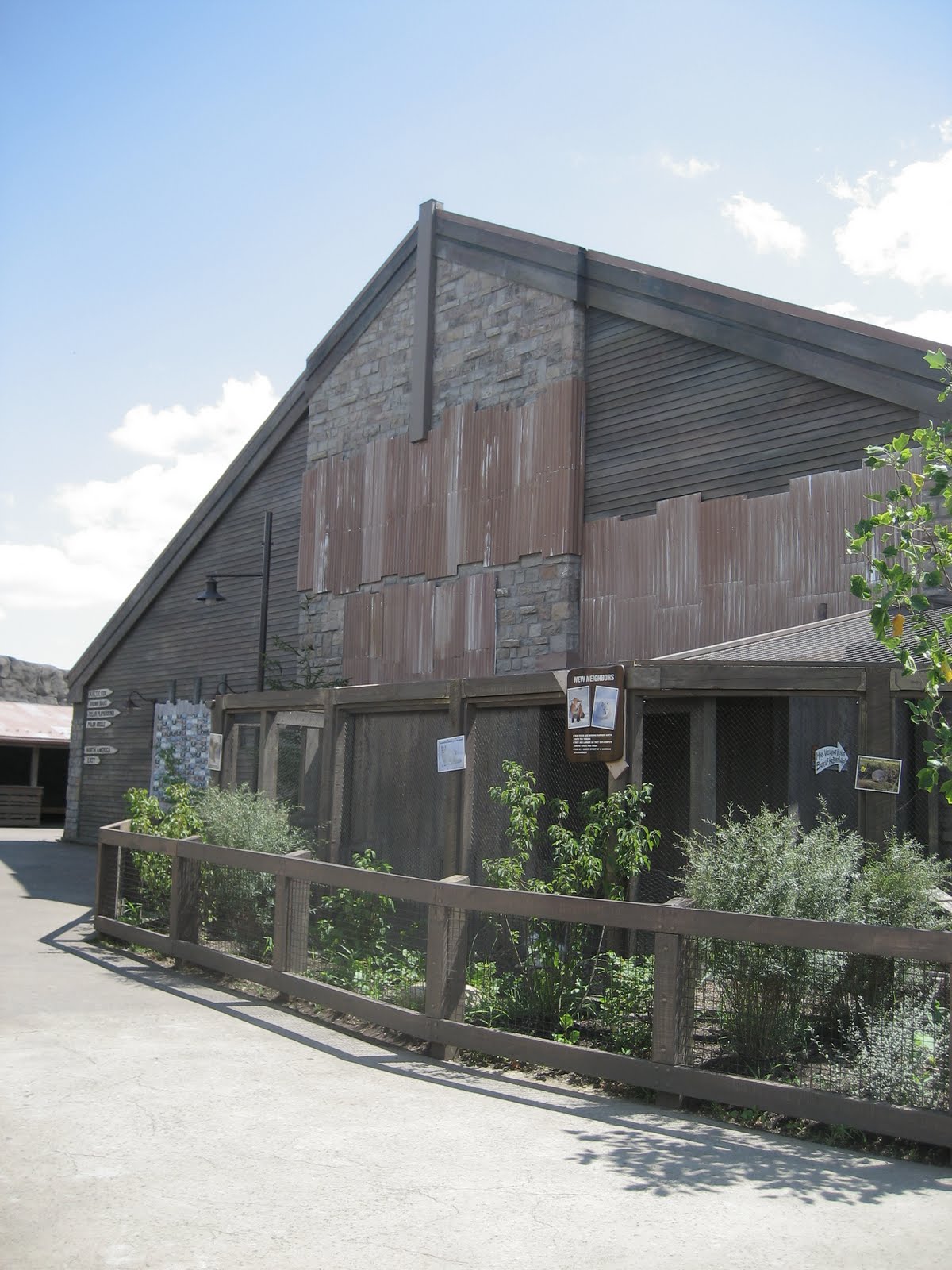
The remarkable thing about this exhibit is that it used to be a church.  And though they've trussed up the outside of the building with wood panels and "arctic supplies," once you've seen what it was, it can't be unseen.  Look closer - you can even tell where they would have hung the cross.

The congregation is still there, they've just moved to a lot closer to the street.  If you stand at the highest point of the exhibit and look towards the entrance, you can see the new church, one lonely little building sandwiched in between parking lots and animal signs.


Don't be too sad about it, though.  The zoo and that church have a long, happily entwined relationship.  It's Mr. Hannah's home church, after all, and the zoo used to let the church have their Easter Sunday sunrise service in the park.  I'm sure the church enjoys the new home.  And perhaps the polar bears are comforted to know they're walking on blessed grounds.    


If you follow the signs to the mine shaft, you'll end up below the exhibit, at the underwater viewing area.  For a brief moment, when we first walk into the glass bubble, a big, white, polar bear butt brushes across the ceiling before it disappears.  We wait for him to come back, but he's long gone, off to seek shady refuge for an afternoon nap.  All that's left behind are the fish, swimming through the clouds like Atmospheric Beasts. 


Wednesday, July 28, 2010

He Can Soothe You Like Vanilla, The Gentleman's a Killer

Behind the iron lung in the Allen County Museum basement is a jail cell and two wax figures.  A prisoner, standing inside the cell with his hands around the bars, staring down the sheriff who sits behind a big desk, pouring over the Lima News.  Against the wall in a big glass display case is a records book, forever open to the same page.  Halfway to the bottom, in neat black cursive, a name, a date, and a crime.  1933.  Bank Robbery.  The man at the desk is Sheriff Jess Sarber, which means the name on the page, and the man in the cell, can only be John Dillinger.

If you saw Public Enemies, you didn't see Johnny Depp waiting patiently in an Allen County jail cell, and you didn't hear one character utter the name "Jess Sarber," but this tragic jailbreak is immortalized in Lima.

The placards on the wall tell the story better than I ever could.  Dillinger and his gang swept through Ohio during the summer of 1933, knocking over banks and nearly uncatchable.  Dillinger himself only got caught in Dayton when he stopped to visit a girlfriend in September of that year, and was jailed in Lima to await trial for a bank robbery in Bluffton.

The important thing to know about the Lima jail is that the jail building itself was built on to the sheriff's house as the world's most unwelcoming house addition.  That's why it's not unusual that both Sheriff Jesse Sarber and his wife, Lucy, were present when three men calling themselves police officers from Michigan City walked in to the jail and asked to see John Dillinger.  When Sheriff Sarber asked to see their badges, they drew their guns instead, shot Sarber in his left side, and demanded the keys to Dillinger's cell.

Obviously, these men weren't police officers.  They were part of Dillinger's gang; Charles Makley,  Russell Clark, and Harry "Pete" Peirpont.  While the bullet Peirpont fired at Sarber worked its way down his leg to sever an artery, Peirpont and Makley beat Sarber with the butt of their guns as his wife cried and begged for his life.  She would be the one to find the key that released Dillinger, but the damage was already done.  Jess Sarber would die that night, and John Dillinger would walk free for another year, until that fateful night in Chicago.  But you've already seen that movie.

Makley, Clark, and Harry Pierpont would be tried for murder almost a year to the day of Sarber's death.  Their trial would be overseen by the new sheriff, Donald Sarber, who watched his father's murderers with one hand on the machine gun resting in his lap.  The black and white photograph hanging on the wall that captures that moment belies the tension in the room.  Sarber leans far back in his chair, one leg propped up over the other, one hand holding the gun at a restive, almost jaunty angle, the other wrapped around his chin.  If you couldn't see his face, you might think he was relaxed.  But his eyes are sharp.  Focused.  There are killers in the room, and he knows it.

There's no one else here in the basement with me, so I reach out and wrap my hand around one of the bars.  The metal is cool under my fingers, making my palm feel indescribably hot.  I wonder how it felt for Mr. Dillinger.  Was he hot-blooded and itching for escape?  Or did he know his men were coming for him, and waited here, calm and confident?  His men found him playing pinochle.  I'm inclined to believe it was the latter.

Tuesday, July 27, 2010

The Ones That Mother Gives You Don't Do Anything At All

When you walk downstairs into the basement of the Allen County Museum, try not to get too  distracted by the iron lung (which is a terrifying thing in person, by the way.  Just thinking about being trapped inside a giant fishbowl with this noisy machine breathing for me makes me claustrophobic).  And don't stare too long at the portrait of Phyllis Diller hanging over the landing, proudly declaring her to be a native of Lima, Ohio.  But when you reach the bottom of the stairs, do look left.

There's a display case hanging from the wall.  It's filled with little objects, most smaller than your finger.  It seems innocuous enough, until you read the title plate fixed to the top of the case.    

Objects Removed from Esophagus, Bronchial Tree (Lungs), and Larynx 
of Patients of Drs. Estey C. Yingling and Walter E. Yingling 

The Yinglings were a father and son act, doctors in Lima who often treated the patients at the Lima State Mental Hospital.  It stands to reason that some of these objects might have been pulled from those throats, but the identifying card each object is tied to makes no mention of where the object was retrieved, just when, who, and how old they were.  There's nothing that says why they held on to and so neatly catalogued their findings.  I can only assume one turned to the other and said "Take a look at this.  Isn't this weird?"

It's an impressive collection, if only for the sheer variety.  It's amazing what some people will try to fit in their mouths.  Some of them are to be expected - lots of buttons and coins, bone fragments from steak and chicken dinners.  More safety pins than I expected.  They're all displayed open, their still sharp points glinting evilly under fluorescent lights.  For my own piece of mind, I imagine they went into the mouth closed.  There's also a handful of rusty screws and nails, mostly pulled from children.  I can only hope that they're rusted with age, and weren't that way when they went into the mouths of babes, but I wouldn't put it past a kid to think a brown nail looks delicious.

Among the stranger things in the display is half of a set of false teeth (the top half, I think), and about five inches of rubber tubing, pulled from a teenage girl.  There's nothing on the i.d. cards that says just how these objects ended up in anyone's throat, but I think, when it comes to rubber tubing, I'm grateful for the mystery.  I don't think I want, nor to I really need, to know how or why a young lady ends up with that much tubing in her mouth.

In case you were wondering, the oldest person in the display is Herbert Painter, who had what looks like a piece of T-bone taken out at the ripe old age of 83.  Thomas Hermiller swallowed a two inch screw at 3 months, which proves you really can't let them out of your sight for anything. 

And my favorite?  Well, I'm partial to the false teeth, but I'm utterly charmed by what looks to be a heart shaped plastic dog tag hanging in the corner, extracted from another Herbert, Herbert A. Norld, aged 8 months.

Wednesday, July 21, 2010

Two by Two in a Big Skidoo

The sign above the door says "Noah's Ark."

"Do you want me to turn those on for you?" asks another Allen County Museum docent, sneaking up behind me.  I try to politely decline, but she's not having any of that.  "It doesn't take hardly anything," she says, barreling past me into the small room. 

Four big wooden cabinets, one pressed against each wall, each with a brass plate carved with the name "J. E. Grosjean" screwed to the top.  No one seems to know much about Mr. Grosjean, or why he devoted so much time to collecting and stuffing the animals crammed into these display cases.  He was an undertaker, once, according to the newspaper clipping hanging next to the door.  An embalmer.  Perhaps he just loved dead things.

"We don't turn that one on anymore," says the docent, pointing to the display closest to the door.  It's full of stuffed birds, all with the same fixed glassy expression, tied to a ferris wheel.  "The feathers are too dry," she explains, "so the movement does too much damage.  But this one works just fine!"  And she pushes a button on the back side of the case marked "Special Albino Collection."

The old cabinet rumbles to life, and so do the animals inside.  Sort of.  A handful of birds spin on a turn-table, and the pink eyes of a white badger moves closer to the glass as the animal darts in and out of its burrow.  The docent makes sure I notice the little bird's nest at the bottom of the display.  "See how it opens?" I do.  "There are little baby birdies inside."  There are.  

(She calls it a nest.  It's actually a human skull, allegedly from Cuba.  I wonder if she knew that.)

After a minute of watching the animals jerk about inside their case, the docent cuts the power, and bustles over to the display titled "Noah's Ark."  "This one lasts about seven minutes," she says, hand disappearing behind the cabinet.  "I'll just turn it on, and you can watch," and she disappears as the motor gurgles to life.  

What happens is a display of first-rate 1901 electric technology, supplemented by a static-filled soundtrack added during a 1966 restoration.  The ark rests on a pile of dirt, twisted vermin carcasses, and snake skins, helpfully identified as "Showing Everything Dead and Destroyed After Deluge."  Little light bulbs flash, and the Voice in the Box pops and hisses the story of Noah and the Ark.  A little set of doors opens on the ark, and out flies a raven, up and up, disappearing behind hand-painted rain clouds.  More lights, more reedy thunder.  A second set of doors opens, and here comes the dove, twig already in beak.  It flies out to the far side of the display, then turns around and flies back into the ark, doors closing behind it.  The big doors of the ark open, and out come the survivors.  In the first row, pairs of carved human figures and stuffed toy animals, like elephants, horses, and lions.  The second row is real stuffed birds, walking two by two.  Together, they all march behind Mount Ararat, where a stone tablet carved with Bible verses swings away to reveal Noah and his family burning a sacrificial lamb.  One last round of flashing lights, and the crackling music tries desperately to sound inspirational, and the whole things hiccups to a stop.  That was weird.  That was wonderful. 

The last case isn't wired.  The card at the bottom of the display reads "This Case Contains Specimens Soon To Be Extinct."  The display was created little over a century ago, but the contents may surprise you.  A number of animals have gone extinct in that time, but more than half of the animals in this case are still around.  Certainly the Duck-Billed Platypus, of which there are two, mounted near the bottom and almost looking over their shoulders at visitors.  Neither is the African Hornbill, nor the Andean Condor, though the latter is still considered 'near threatened.'  Only the lone Ivory-Billed Woodpecker is critically threatened, though not officially extinct, so at least Mr. Grosjean got one right.  

A group of teenagers come in (with the docent, naturally), and since the room is barely big enough to hold just me, I make a hasty exit.  Though I can't help the feeling I'm being watched while I leave.

Tuesday, July 20, 2010

I got this tip from Roadside America.  Things Swallowed! it said.  Death Masks! it said.  Taxidermy! it said.  It didn't come right out and say it, but it heavily implied that the Allen County Museum might be a Things in Jars museum, which, of all the museums, might be my favorite kind.  All of that weird stuff right at my fingertips, and all it takes is the short drive up to Lima, Ohio (yes, Glee fans, it does exist!).

The Allen County Museum is a museum of gifts.  Every artifact comes with it's own little placard, finished with the words 'Donated By,' or 'Gift From.'  I wonder how long some of these pieces were left in Lima attics, gathering dust while the family puttered around below thinking, "Oh, we can't just throw Grandpa's gramophone away.  It's practically historic!"  Did the artifacts demand a museum of their own?  Or did the museum send out the call for Lima's near forgotten relics?  

19th Century Homestead says the sign on the wall in the first big room.  The big display of an 1800's kitchen dominates the room, and really makes a show of how much the kitchen was the woman's space.  There's a spinning wheel next to the fireplace, far enough away that the wool won't catch the embers, but close enough that the prairie mother can still be productive when she's doing something as trivial as making dinner. 

I get a bit waylaid by a display case full of 19th century cutlery.  Some of the pieces look very familiar (you'll be happy to know that forks, knives, and pie crimpers have remained unchanged by time) while others sound familiar, but look much different than expected (the nut cracker looks...problematic, while the baby bottle looks a bit like a dalek).  Still more look charmingly archaic.  Who uses a butter mold, anyway? 

At the end of the case is a collection of tiny little irons, matching with tiny little dresses, and a tiny little washboard propped up in the corner, all perfect for tiny little girls who need to learn how to be tiny little homebodies.  

A docent corners me next to the covered wagon.  He's just itching to tell me all about it, and that pack of children that just went racing through the exhibit aren't likely to listen, so I let him.  He rests an elbow on one of the wagon's big wheels and describes a family pushing everything they owned into the wagon, then walking along beside it.  "No riders on the covered wagons," he says with a grin, then wanders away.  I never quite know what to think about docents.  Do they just have incredible amounts of knowledge tucked away in the corners of their brains, or do they collect informational odds and ends and then wait to spring it on unsuspecting visitors, whether they want to hear it or not?  Watching the docent hover by the covered wagon with an eye trained a young couple that's just wandered into the room, I suspect it might be the latter.

A line of Burma Shave signs hung from the ceiling draws me in to the next room.  

Dear Lover Boy
Your Picture Came
But Your Doggone Beard
Won't Fit the Frame!
Burma Shave

There's a big, horse-drawn hearse in the next room, and I can just see the glass eyes of stuffed birds peeking around the corner.  This might just get interesting.

No pictures in the museum, I'm afraid, but come back all this week to learn about Noah's Ark, John Dillinger, Mt. Vernon, and the rest of the Allen County Museum.   

Tuesday, July 6, 2010

I Will Buy You a Garden Where Your Flowers Will Bloom


The flowers are in bloom in Wegerzyn Gardens, yet another part of the Five Rivers Metropark system.  As the parks go, it's not as vast as Cox Arboretum, or as deep as Carriage Hill, but there's a simple elegance to the flowers, and on this stuffy July day, it's refreshing to get out in the fresh air and hear the buzzing of the bees.


It so colorful.  Reds, blues, yellows, whites, and strange combinations of every color you can't name paint the walkways.  Little flying creatures buzz from one blossom to the next, bumblebees defying physics yet again, dragonflies zipping past your head so quickly you can't hardly see them, and the ever-present butterflies that were so exciting to see weeks ago and are now a lovely coincidence.  It's mostly quiet, save for the chirping insects and the odd, delighted squeals from the kids splashing around in the Children's Discovery Garden.


The garden feels like every book you ever loved as a child.  Over here, it's Alice in Wonderland.  With that lamp post, it's The Lion, The Witch, and The Wardrobe.  That barren field where the Ash Trees used to grow might just be Great Expectations, if only a bit more abstract. 

 
(You might not have loved Great Expectations as a child.  I wouldn't say that I loved Great Expectations as a child.  I can't even say that I love Great Expectations now, but it seemed, somehow, so appropriate.  Sorry.)


Next to the gardens is the boardwalk that takes you through the swamp.  It's cooler under the trees, but the branches hang on to the air, and the humidity clings to your skin like spiderwebs.  As do the actual spiderwebs.  Silk strands strung between the beams glisten under a captured ray of sunshine.  I do my best to avoid them, but I still feel the ghostly dance across the back of my hand, tugging on the hairs of my arm.  It's an eerie feeling, on of the reasons I hate spiderwebs.  (The other reason being SPIDERS.) 


Dirt paths lead away from the boardwalk, deep into the woods.  It's tempting, but the mosquitos are out in full force today - I've already got a bright red welt swelling on my pinky finger.  Perhaps another time, when I'm better prepared.


Like all good things, the children's Discovery Garden is infinitely cooler than anything else Wegerzyn has to offer.  Someday, when I'm rich and famous, I'm going to build a park where adults can get wet and dirty and stick their fingers into strange places and find little secret hidey-holes that they can crawl into and spy on people.  And a dinosaur.  Discovery is not just a child's medium.  I still like to play.


HTML hit counter - Quick-counter.net