Friday, June 11, 2010

Insert Fleetwood Mac Song Here

I went to film school once, for a brief moment in time.  Fall of 2005, but it feels like half a life time ago.  I had these great designs about writing and directing my own movies, like I could be the most significant lady filmmaker since Leni Riefestahl, but without all the Nazi propaganda.  Obviously, that didn't pan out, and I didn't stay there long.  But I do remember what the dean said at the freshman assembly.  "Life won't always open the door for you.  When the door is closed, build a new door.  Make your own opportunities."

He was talking about independent movies.  I'm transposing to the blogosphere.  And why not?  It's appropriate.  No one's going to ask me to write about being a tourist, so yes.  I've created my own venue.  

But why be a tourist?  Aren't tourists universally hated by locals, defined by their straw hats and fanny packs and annoying habit of stopping in the middle of the sidewalk to take a picture of a historically significant bank building?  Aren't we all a little embarrassed to see (or be seen with) that guy with the Hawai'ian shirt and the big camera around his neck?  Isn't it a point of pride to live in New York City and never visit the Statue of Liberty, or in San Francisco and not care about that gorgeous bridge, or in Las Vegas and never eat at a casino buffet?  

Possibly.  (Definitely.)  And let's face it; an American tourist is generally considered to be the worst of a bad breed - we push our way to the front of the group, we've got the video camera permanently attached to our faces, we talk loudly and slowly to our English speaking tour guides, just in case.  All for the superficial understanding of something close to culture.  

Is it worth the lousy reputation, I can't imagine not going to a place for the sake of not going.  What will you do then, when you've missed your chance?  Will you be happy to have not seen that thing, that place?  Will you wish you had gone while you still had your legs?  Will you have wondered why you were too good to see this world before you, tourists be damned?  Will you regret?   

I'm not too good to be a gawker.  I'm not above carrying my camera with me at all times.  I love finding the ugliest, tackiest souvenir, just to have something to put of my shelf, something to remind me that I was There, and It was great.  I'm not ashamed to have seen as much as I have, nor will I stop trying to find the most strange, most obscure, most famous, most beautiful places in my country, and others.  I'm proud to be a tourist.  I will regret nothing.  I hope you don't mind too much.      

Thursday, June 10, 2010

Turning Up and Turning Down and Turning In and Turning 'Round

WARNING: this post contains my big fat face.  It may be the only time this ever happens, though, and it's covered with make-up, so don't be too scared, but proceed with caution.


Kyoto, Japan.  Summer, 2003.

After Julie and I are settled into our (gorgeous) hotel room, Fushiko knocks on our door.  She has a surprise for us.

The sign over the door says "Yumekoubou Studio," but there's not sort of indication as to what it's a studio for.  Until we walk down the hallway, and every inch of the wall is covered in pictures of geishas.  Geishas on the street, geishas against a backdrop, geishas on the temple stairs.  There's a rack of kimono's against the far wall, next to a line of make-up mirrors, and across the room from a colorful back drop.  It's a dress up studio.  Julie and I get to be made up like geishas. It's somehow more elegant that those tourist trap studios on every boardwalk, the ones where they drape garments from the Old Timey West over your real clothes, then sepia tone the pictures. 


One woman puts a hairnet over my head when I sit down at the mirrors, and sets to work geishafying me.  It looks pancake thick, but that white make-up is a powder.  I barely feel it go on.  I'm more concerned about that hairnet.  My hair is the shortest it's ever been at that point (not counting that time I was bald, several years later), but it's just long enough that being crunched under a hairnet and stuffed under a wig that I'm going to have such fly-away hair by the end of it.  I'll ask for a comb when the wig comes off, any thing to push it back into shape, but to no avail.  I have to walk back to the hotel looking like I've stuck my finger in a socket.


The make up goes on quickly.  It's the wig an kimono that are the difficult parts.  My head's not quiet the right shape for these (heavy) headpieces.  They put on and take off at least three different pieces before they find the one that doesn't pull away from my face and threaten to fall down my back.  It takes three of us to put on the kimono: I hold my arms up away from my body like an airplane, and the first woman folds the sleeves around my elbows.  She then folds the heavy silk skirts up against my stomach while a second woman circles me with strips of linen, tying it all in place.  The obi sash is relatively painless, until they hook the big bow onto the back.  Between the wig, the bow, and the heavy kimono, I must be wearing an extra thirty pounds.  I avoid stepping into the high platform sandals as long as possible.


"Look here," says the photographer.  "Don't smile."  Not that I would.  I take pretty good care of my teeth, but against the white make-up they look horrifyingly yellow.  If you didn't know me, you'd think I'd smoked since birth.  Hauptmen Sensei, my Japanese teacher back in the states, says that you don't see many smiles in Japan; she told us it was because quality dental work used to be hard to come by, and no one wanted to show off their less than perfect teeth.  I don't know if that's the reason, but I do know this - I have a series of photos taken of Julie, Fushiko, and myself as we visit the temples of Kyoto.  Julie has a big, toothsome smile in all of them.  I smile in most of them.  Fushiko doesn't even grin in any of them.


Julie's Vietnamese by blood, so the whole thing sits on her much better than it does on me.  It really emphasizes just how much this geisha make-up is designed to highlight the natural beauty of Asian features; the roundness of the face, the shape of the lips, the slope of the eyes.  Look at the pair of us - Julie looks beautiful. I look like a rogue Cirque du Soleil performer.  But I feel beautiful, too.  


After, when the make-up comes off, and I'm running my fingers through my hair, trying to make it lay flat, Fushiko tells us to pick our three favorite photos, then surprises us with bookmarks with our faces on them.  Julie's photos look a bit more authentic than mine, which I remember at the time thinking wasn't quite fair, but there's really nothing I can do about being so achingly caucasian.  No, I wouldn't make a very pretty geisha, but after all the trouble to trying to look like a fake one, I don't envy those women who do.  


Wednesday, June 9, 2010

Woodland: Persons of Interest


Allegedly, if you stop by the office at the main entrance at Woodlawn, you can pick up a map of the grounds, complete with tour stop information and indicators of famous graves.  I saw allegedly, because I've never actually seen this map in person.  The office is empty when I walk in, and there's not a map to be found.  I'll see them out later as I drive through the grounds, cemetery attendants ( funereal directors?  grave peddlers?  Who are these people, and what are they called?) showing prospective internees the very latest and most exciting locations.  Selling final resting spaces like they're selling cars.  It's not disturbing, exactly, but it is striking how business-like the whole thing is.  I can only hope I can be so composed when planning my own burial.

But I'm not here for burials.  I'm here for graves.  Famous graves.

The name Johnny Morehouse might not mean anything to you, but it's arguably the most recognizable grave in Woodland.  It's so well known, there's a little marker next to the site that says "Tour Stop 1."  Little Johnny's first in line. 


The story goes that five-year-old Johnny fell into the Miami & Erie Canal while playing near his home.  His faithful dog jumped in after him, and managed to pull the boy out, but not in time to save his life.  That part is true, but the legend that follows is a classic one; the dog was so bereft at the loss of Little Johnny that he sat at the grave morning, noon, and night.  Visitors were so concerned, they began to leave little plates of food for man's best friend.  

Toys and coins are still left behind for Little Johnny.  It's highly unlikely that any of these people are connected to the Morehouses in any way, but the tradition lives on.  There's a woman who walks the cemetery every day who collects the coins left behind on Johnny's grave, and uses the money to buy another small toy for Johnny's collection.  


Undeniably, the most famous grave at Woodland belongs to the Wright brothers.  There are plenty of Wright's here, but only Orville and Wilber are buried under the Ohio and American flags.  This is the first time I've encountered pennies left behind on gravestones.  The internet tells me that this is a sign of respect, that visitors leave behind coins to honor the legacy of the deceased.  (Folklore also says that if you drop a penny on a grave and make a wish, the person's spirit is honor bound to help it come true.)  The next time I visit a cemetery, I'm bringing with me a pocket full of pennies.


Just beyond the Wrights is a purple flag marking the grave of Paul Laurence Dunbar, one of America's first prominent African-American poets.  Set against his memorial stone is a marker for his wife, Alice Dunbar.  I don't know if she's buried here - she died in Philidelphia 29 years after her husband's passing, and remarried twice.  Alice was a prominent poet, journalist, and activist in her own right - I imagine if she were also buried here, Woodland wouldn't hesitate to claim her.  


Someone's left a pair of quarters on Paul's stone - a friendly competition with the Wrights?  They knew each other in life - Paul went the same school as the Orville and Wilber.  In fact, his first writings appeared in a paper put out by the brothers, who owned their own printing press.  They later invested in the Dayton Tattler, the area's first African-American paper, edited and published by Dunbar.  Small world.


The last grave I want to see is the marker for Erma Bombeck.  There's a helpful sign to point me the direction of her final resting place.  I follow the arrows and look.  And look.  And look.
There are no words on Erma's grave, nothing to indicate that here lies a person.  If you don't know what you're looking for, you'd never find it.  Up until the writing of this article I thought I'd missed her completely, until I saw a picture of her memorial and realized that she and I had been together the whole time.


I snapped a picture of the stone because there was a wreath against it.  I didn't know it meant anything at the time.  The rock comes from Arizona - Erma's husband Bill wanted to remember her with a piece of Phoenix, where the pair spent 25 years together.  Erma herself was a well-respected journalist and humorist before she died.  I think this unmarked grave might be her last great joke.

There are plenty of other famous graves at Woodland: Leslie Carter, 'The American Sarah Bernhardt"; Levi and Matilda Stanley, the King and Queen of the Gypsies; George P. Huffman, maker of Huffy Bicycles; and too many more to mention.  Plan your own visit to Woodland, and see a bit of history.       

Tuesday, June 8, 2010

Woodland


Cemetery's used to make me really uncomfortable when I was younger.  Standing in front of a headstone, reading the words carved there, I'd suddenly realize that below my feet was a box, and in that box was a body.  What's left of a body.  Bones and dust that belonged to a person who was loved once, and is now nothing more than a name and a date.  And I'd try not to cry when I thought that someday, that will be me. 

I was a bit of a fatalist as a child.  Emo before I knew what the word meant.  I've grown out of it enough to visit a cemetery without being overwhelmed by the inevitability of my demise, but not enough to forget that there a people down there.  


Walking through Woodland Cemetery in Dayton, I find myself saying "Excuse me" when cut between the graves, or "Pardon me, Fannie" when I lift a fallen branch or brush away some dirt for a better picture.  I apologize when I trip over the stones so small they're little more than nubs in the overgrown grass.  I wonder about those little stones; were they bigger once?  Taller?  And they've now been so broken and so weathered that they've been worn down to these little bumps on the ground?  Or was the family simply too poor to afford much more than a bare minimum marker for the grave, so they've placed this little stone here for remembrance.  I find a few little stones with initials stamped on the top; I think it might be the latter. 


Memorial Day wasn't that long ago, any many of the graves still have their flags and wreaths, though there's a helpful sign at the entrance informing all visitors that these decorations will be removed and disposed of by the end of the week.  With the exception of the solider's plot in the front section, I stay away from those marked with memorial wreaths, ribbons, and flowers.  I doubt their family intended for their veterans to be my photo op. 


Woodland's an interesting place.  It's mostly hill, and there's  line of mausoleums built along the road, right into the side of one of the mounds.  It's a big monument cemetery - Dayton used to be where the money went, and anyone who could afford a big rock, got the biggest rock they could.  There are a lot of obelisks, leaving the landscape looking like it's dotted with hundreds of tiny Washington Monuments.  There are enough oversized crosses for the cemetery to host a "Crosses of Woodland" feature on their website, and many, many angles.  Angles with their hands raised in praise.  Angles mournfully touching the family stone.  Angles weeping at the feet of the family plot.  Those might be my favorite kind.


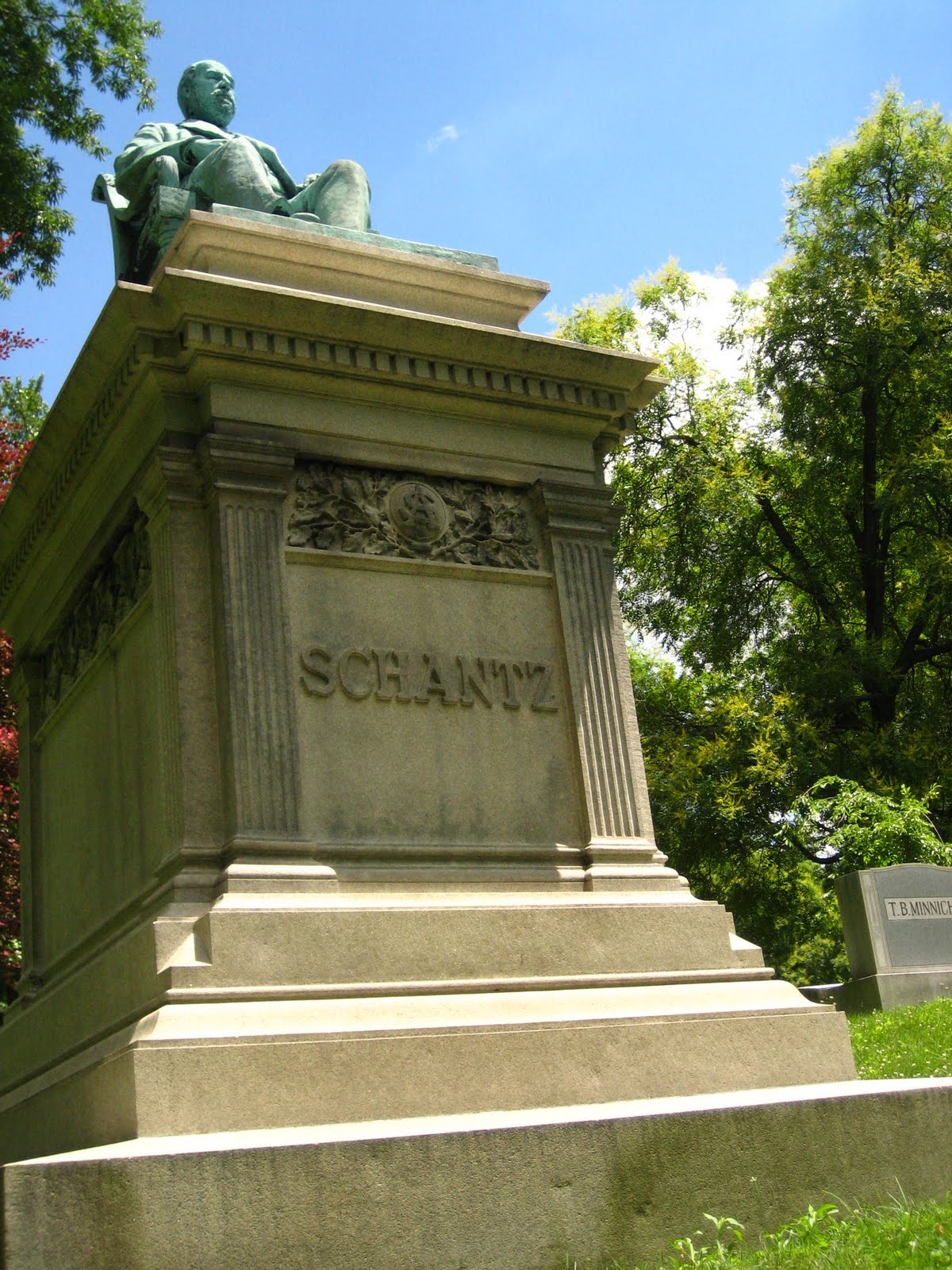
I do tend to gravitate towards the more audacious graves, the ones that are so over the top they start to suggest at a sense of humor from the person who commissioned it.  There's a copper statue of a man at the Woodland entrance, reclining in his chair atop a massive block of concrete.  It's the first thing you see when you drive in, and how could you not?  It's huge.  It demands your attention.  Clearly, this is a man who understood that the dead have no need for modesty, and I salute him for it.  This is his only lasting impression, and now everyone who walks through the gates will notice him.  I hope I can be so bold.        


I walk too far looking at the names.  There's a strong line of German heritage in this area of Ohio, and I try to spot which surnames used to have an umlaut.  Did poor Oliver Gunkel's family lose something in the Americanization of their name?  And what about the stones that just say "Mother" or "Father" or "Mary"?  There's no family plot stone to say who they belonged to, nor are there dates on these stones, saying when they died.

I end up in the Greek-Orthodox section.  I can tell it's the Greek-Orthodox section because of all the Greek.  


I've also walked as far as I can go, and it's much further than I intended.  There's a fence in front of me, separating the cemetery from the great beyond, and I've walked up an down so many hills that if I can no longer see my car.  I know that if I just put my back to the street and walk in a thiswardly direction, I'll eventually find it.  Or I'll end up back at the entrance, and I can pick up one of those maps they (allegedly) have on offer.  Squaring my shoulders, I start the trek back up the hill.     

And there in front of me at the top of that first hill, is this: 


Preserved Smith.  Were it not for actor Benedict Cumberbatch, Preserved Smith might be my favorite name ever committed to a real person.  The heartiness of "Smith."  The descriptiveness of "Preserved."  We don't much name our children for adjectives anymore.  Or words in general (unless your a celebrity scientologist.  Pilot Inspektor, anyone?).  But the virtues still remain.  

(I don't know for certain if this Preserved Smith is the Preserved Smith, but wouldn't it be a tickler if it was?  The man died in Kentucky, but he was born in Cincinnati, so let's assume they're the same man.  Just how many Preserved Smiths can there be, anyway?)   

Come back tomorrow to learn about some of Woodland's most distinguished guests.

Monday, June 7, 2010

Letter to a Baby Tourist

Many years ago, when I was too young to appreciate it, my mother wrote me letters.  She told me about herself, and myself, the things we were doing, and the things we had done.  Every adventure starts somewhere, and this is the start of mine.  Enjoy.

June 26, 1987

Dear Baby Tourist -

You are now six weeks old.  You are the joy of my life and I love you more every day.

This past week you have started to smile at people.  You always smile at your dad first thing in the morning; I know it's a nice way for him to start his day.  I feel so proud that you have learned a new thing.

The last two weeks Aunt Judy has stayed with us to help take care of you.  You were a good girl for her, and she liked being with you.

Today we leave for a week's vacation in Michigan at the cottage in Glen.  This will be your second trip to Michigan.  You and I went to visit Grandma M for a week when you were 3 weeks old.  You met Uncle Joel and Aunt Karen, Uncles Todd and Gregg, and Aunts Heidi, Joy, and Judy.  We also spent a day with Grandpa R and Becky and Holly and your Great-Grandma and Grandpa R.

Sunday June 7 we spent the day with Grandma and Grandpa P, and Aunt Jan and cousin Mike.  We also introduced you to Great-Grandmother W and Great Aunts Debbie and Sherrie and Great Uncles Art and Bob.

On Memorial day Uncle George and Aunt Shirley stopped to see you on their way to Tennessee.  Soon we hope to visit your Great-Grandma P.

Dad and I like showing you off because you are such a sweet, pretty girl and we are proud of you because you are ours!

Baby Tourist, you have changed my life so much.  You have helped me learn to be patient, and to know what is important and what isn't.

What is important is providing you with lots of love and security to make you feel safe and happy.

I am so lucky to have you.  You and your dad are the most important people in my life, and I thank God for making us a family.

I hope you will always know we love you.  I've mad a promise to myself that I will tell you every day.

You are crying now, so I'll end this and go to you-

Love, Mom.  

Saturday, June 5, 2010

Sand it Black


Hawaiian Big Island.  Winter, 2008.

Punalu'u Black Sand Beach is an instant beach.  It's not really sand.  This beach, and many like it, were formed when hot lava from the volcanoes rapidly cooling and exploding when it hits the waters surrounding them.  The stones are smooth, polished by the years of being turned by the tides.  Maybe in a handful of centuries the grains will be worn down to a fine, proper sand.  For now you can feel them crunch and slide under your shoes as you walk along the shore.  The sand is fine enough to walk over with bare feet, but coarse enough to hurt when it gets stuck under your toenails.  I recommend you be properly shod.


And you wouldn't want to take to the tide pools without protecting your footsies, anyway.  This isn't really a beach you come to for swimming (and with sharp underwater rocks and little protection from the currents, you wouldn't really want to), so the big draw are the hidden pools tucked away in the larger lava formations.  The crabs may scurry away when your shadow falls over them, but the sea urchins aren't going anywhere.  The fish don't often make it up to the tide pools, but when they do, the sun glitters of their vibrantly colored backs.  Blues, reds, greens.  Little pools of rainbows. 


White pebbles pop against the black sand like stars against the night sky.   Visitors who've come before me have left behind simple messages - a stick figure, an initial, a cat.  I leave a little smiley face behind a rock. 


Local tradition says that those who take rocks or sand away from the beach (or the islands, depending on who's doing the telling) will be cursed by the fiery Pele until the stones are returned.  I've had a Pepsi bottle full of black sand for a year and a half without too much tragedy befalling me (yet) so I don't know how much stock I put in that legend.  Though a display case in the lobby of Kilauea Military Camp has a small collection of rocks mailed back to the island after their captors hit a wall of bad luck, so make of that what you will. 


(Interesting to note: while that's perpetrated as being an ancient belief, historians can only trace the myth to the 1920's.  They believe park rangers invented this little piece of fakelore to prevent visitors from packing their pockets with pebbles.  Maybe I should return that Pepsi bottle after all.)


Further up along the formations, too high for the waves to reach, the lava rock twists and turns, forming high peaks and shallow crevasses.  It's been raining since we've set foot on the Big Island, but we've been afforded this rare moment of sunshine, and the light casts long shadows across the lava-formed walls, making faces in the rocks.  Moss grows in the bumps and tubes - food for the tiny crabs that scuttle into their hidey-holes when we stand too close.


Standing at the lava's edge, we watch the waves crash into the rocks.  The water doesn't quite reach us, until suddenly it does, and we're too shocked to get out of the way in time.  Our toes squelch in our shoes, and it's starting to rain again.  It might be time to go.


Friday, June 4, 2010

Children At Your Feet. Wonder How You Manage to Make Ends Meet.

There's a woman standing on the side of the road in Springfield, Ohio.  We've passed her and her children many times before without recognizing her.  All day she stands there, all day she watches.  She holds her children close to her, and glows a warm pink in the light of the setting sun.  She is a mother.  She is a wife.  She is Madonna of the Trail.


There are twelve Madonnas positioned across the continental United States, all but two facing westward.  Following the line of the National Old Trails Road (now mostly Rt. 40 and Rt. 66) from Bethesda, Maryland to Upland, California, these women were erected to honor the women of the frontier, the wives and daughters who were so strong and who so loved the men with whom they crossed the nation.  The presence of these women established the expansion of the American territories as much as their adventurous husbands did, and for this they are recognized.

In 1911, the Daughters of the American Revolution formed the National Old Trails Road Committee, and were tasked with the establishment of the route as a National Memorial Highway.  The dawn of World War One delayed the formal start of the project, but in 1924 Congress approved the plan to erect twelve statues along the Memorial Highway.  German-American sculptor August Leimbach was drafted to design the statue.  He describes his woman as such:

"When I came to America, I often saw these people of the pioneer type, strong and brave and always ready to protect themselves against any danger. Asked to make a sketch model for a monument of a woman of pioneer days, I was inspired by my own impression of these people I had met, and the Madonna of the Trail is the result."


And this woman is no dainty bread maker or house keeper.  She's a sturdy woman, face turned to brave the west.  She holds her baby with one arm while her son clutches her skirt.  And in her free hand?  A rifle.  No, this is no ordinary woman.  This is a woman who built homes.  This is a woman who conquered lands.  

The algonite stone used to build her heavily features Missouri granite, which causes her healthy pink coloring.  I don't know if they did that on purpose, if they thought that casting her in this delicate, feminine color would soften the harshness of her dominating figure.  The color doesn't soften her, not exactly.  Instead, it lends her an air of motherly stoicism.  Now she has a hint of personality, more than you might find if she were just another stark white memorial.


On July 4, 1928, at the dedication of the first statue, the one right here in Springfield, the leader of the National Old Trails Road Committee, then Judge (but soon to be President) Harry Truman said of these women:   "They were just as brave or braver than their men because, in many cases, they went with sad hearts and trembling bodies. They went, however, and endured every hardship that befalls a pioneer."  Within the next nine months, each of the twelve identical statues had been placed and dedicated, the final one resting at the start of the trail in Bethesda, Maryland.  They've since become a source of local pride, with the community taking care to see that their women are not defaced, or too harshly weathered.  They still stand today, that strong line across the country.

I still drive past our Madonna.  I am glad now to know her name.  

HTML hit counter - Quick-counter.net